Konstantin Grouss
The Press Page
Twenty-three years of independent press, in one place — including eleven articles you cannot read anywhere else.
Press
Ninety-five sources — reviews, interviews, profiles and institutional records, 2003–2026, in four languages — from a Vedomosti review of a Cage concert in 2004 to a Snob retrospective in 2025. Twenty-two of them are not on the web at all; the eleven that can be reproduced are published here in full — scan, full text and citation.
Selected
Ten pieces across twenty-one years. Quotations are in the language they were written in.
Vedomosti
«…с участием бригады настоящих ударников и группы танцоров из пластического театра ZERO»
‘…with a brigade of real percussionists and a group of dancers from the plastic theatre ZERO’
The earliest independent press notice of the company that exists — a national daily, reviewing the opening night of Alexei Lubimov’s sixtieth-birthday festival.
«Искра · Spark»
«[ZERO] — в смысле свобода, покой, отправная точка, из которой ты можешь сделать шаг влево, шаг вправо, и в которую ты всегда можешь вернуться»
‘[ZERO] — meaning freedom, stillness, the point of origin, from which you can take a step to the left, a step to the right, and to which you can always return’
The earliest interview that exists: two pages on Theatre ZERO, billing him as ‘artist of dance, choreographer-improviser’ — and the clearest account he ever gave of what ZERO meant.
Moskauer Deutsche Zeitung
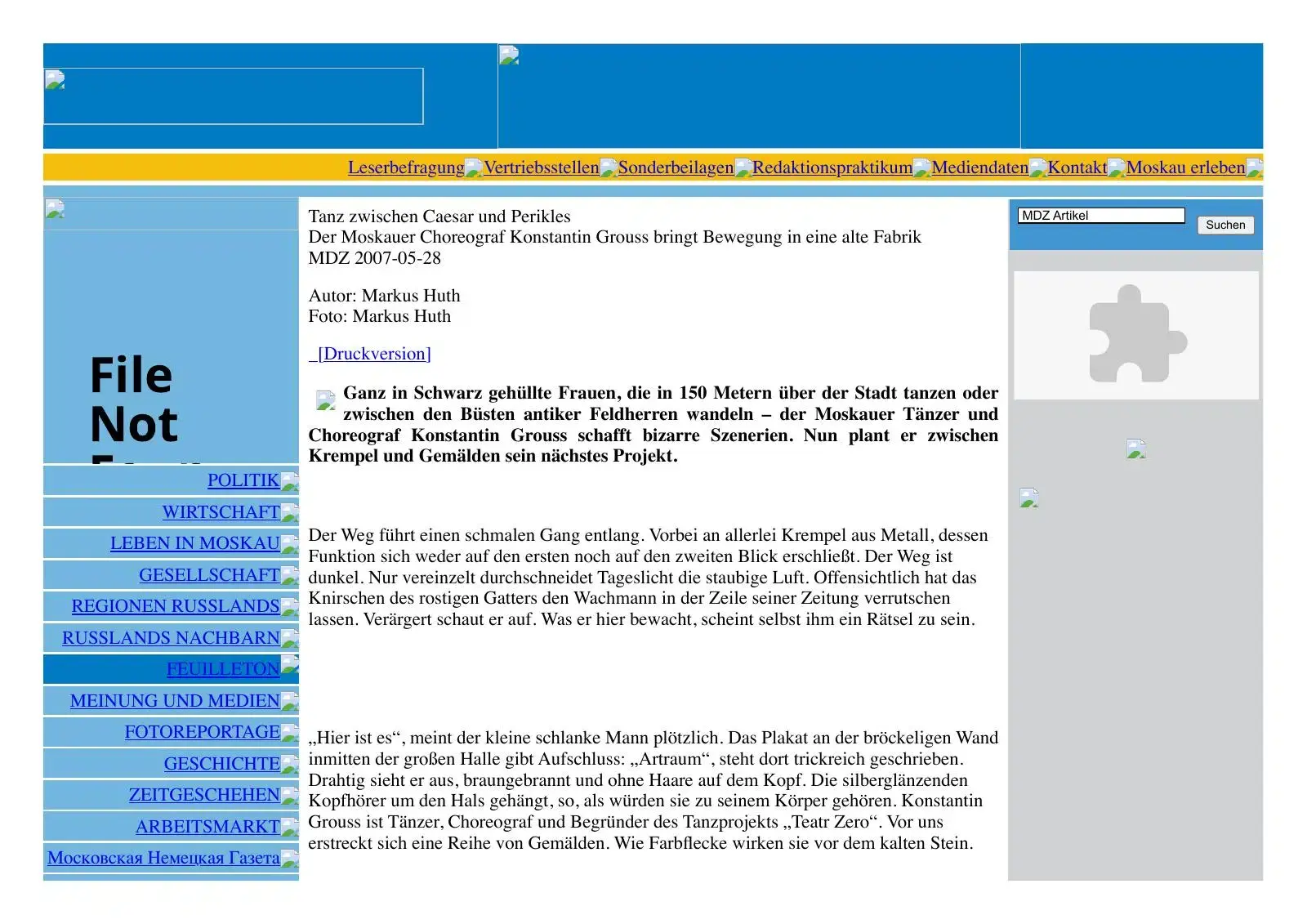
«Ganz in Schwarz gehüllte Frauen, die in 150 Metern über der Stadt tanzen oder zwischen den Büsten antiker Feldherren wandeln»
‘Women wrapped entirely in black, dancing 150 metres above the city or walking among the busts of ancient generals’
A full profile, in German, in Moscow. The most biographically informative article ever written about him.
«Заполярный Вестник», Norilsk
«энергетика, которая исходила от главного героя, передавалась его партнёршам и всему зрительному залу»
‘the energy coming from the protagonist was passed to his partners and to the whole auditorium’
The Russian premiere of Cage for Air, reviewed — and the printed confirmation that the Prokhorov Foundation supported it.
Vremya Novostey
«С этой задачей фестиваль не то чтобы героически, но легко и элегантно справился»
‘The festival met that task — not heroically, but lightly and elegantly’
No Translations, reviewed by one of the country’s serious art critics. The paper closed in 2011; its archive still stands.
«Театральный МИР» №11
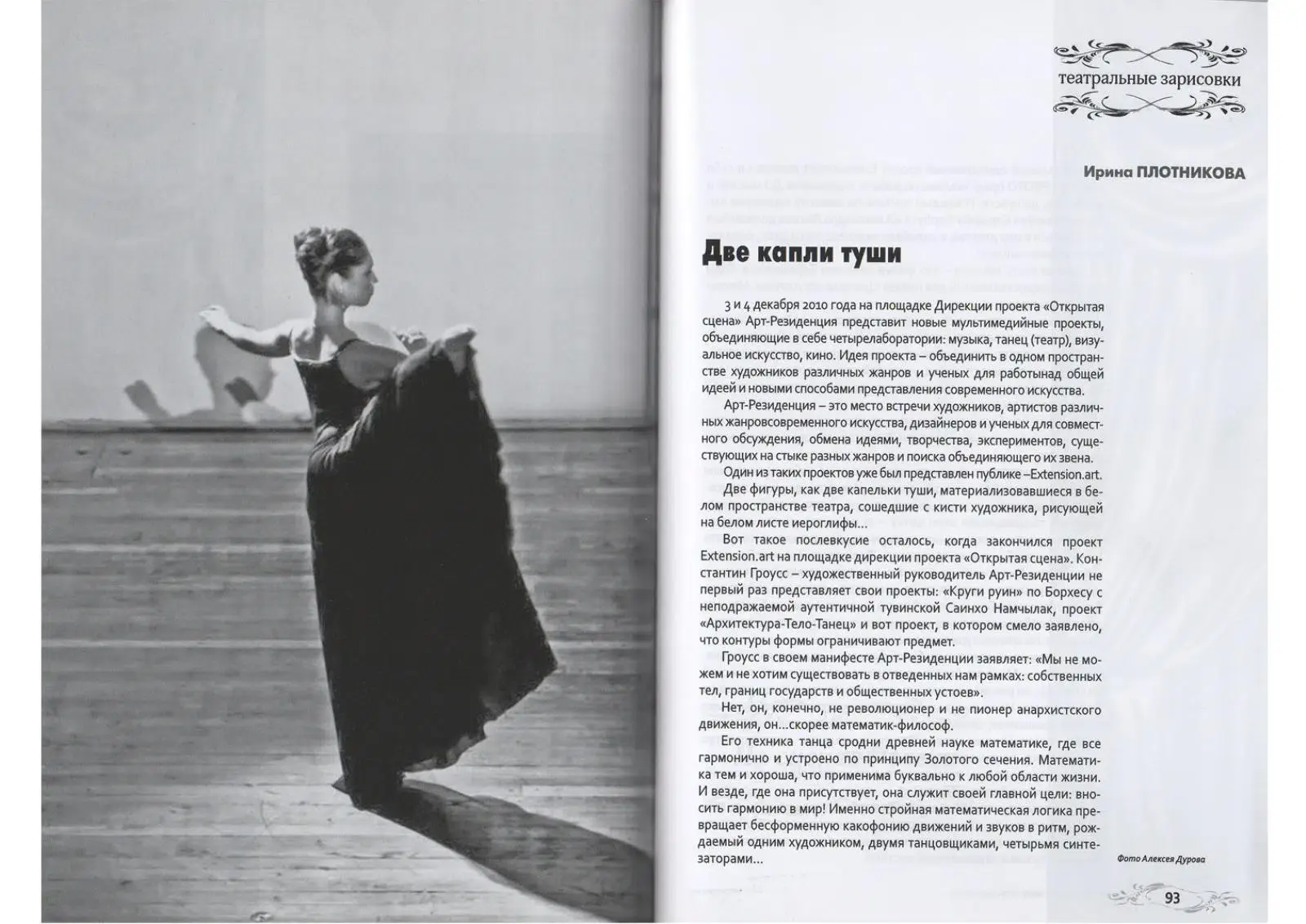
«он, конечно, не революционер… он скорее математик-философ… Не архитектура тела, но архитектура души»
‘he is certainly not a revolutionary… rather a mathematician-philosopher… Not the architecture of the body, but the architecture of the soul’
The best description of the work anyone outside it has written.
Kommersant Weekend
«выходят в этом соединении далековатых вещей на новый уровень»
‘they seem to take this joining of far-apart things to a new level’
Code of the Epoch at the All-Russian Museum of Decorative and Folk Art. The most authoritative critical assessment any project received.
not online
Moskovskie Novosti
«Танец Гроусса впечатляет. В нем действительно важна энергия, которая становится вторым главным действующим лицом номера»
‘Grouss’s dance is striking. Energy really does matter in it, becoming the second protagonist of the piece’
The fullest published description of him dancing. The outlet is gone.
Il Tirreno, Pisa
«Il corpo nella corrente di informazioni prende una forma dopo l’altra»
‘The body, within the current of information, takes one form after another’
NavigArte. The same thesis he first wrote down in 2003, in a third language, thirteen years on.
Snob
«Первые кураторы — Константин Гроусс и Дмитрий Алексеев — задали мощный старт»
‘The first curators — Konstantin Grouss and Dmitry Alekseev — set a powerful start’
Fifteen years on, a national outlet writing the festival’s own history still opens it with his name.
Abroad
Five items, four languages, three countries, thirteen years apart.
Moskauer Deutsche Zeitung
«Tanz zwischen Caesar und Perikles». A full profile in German.
The Irish Times
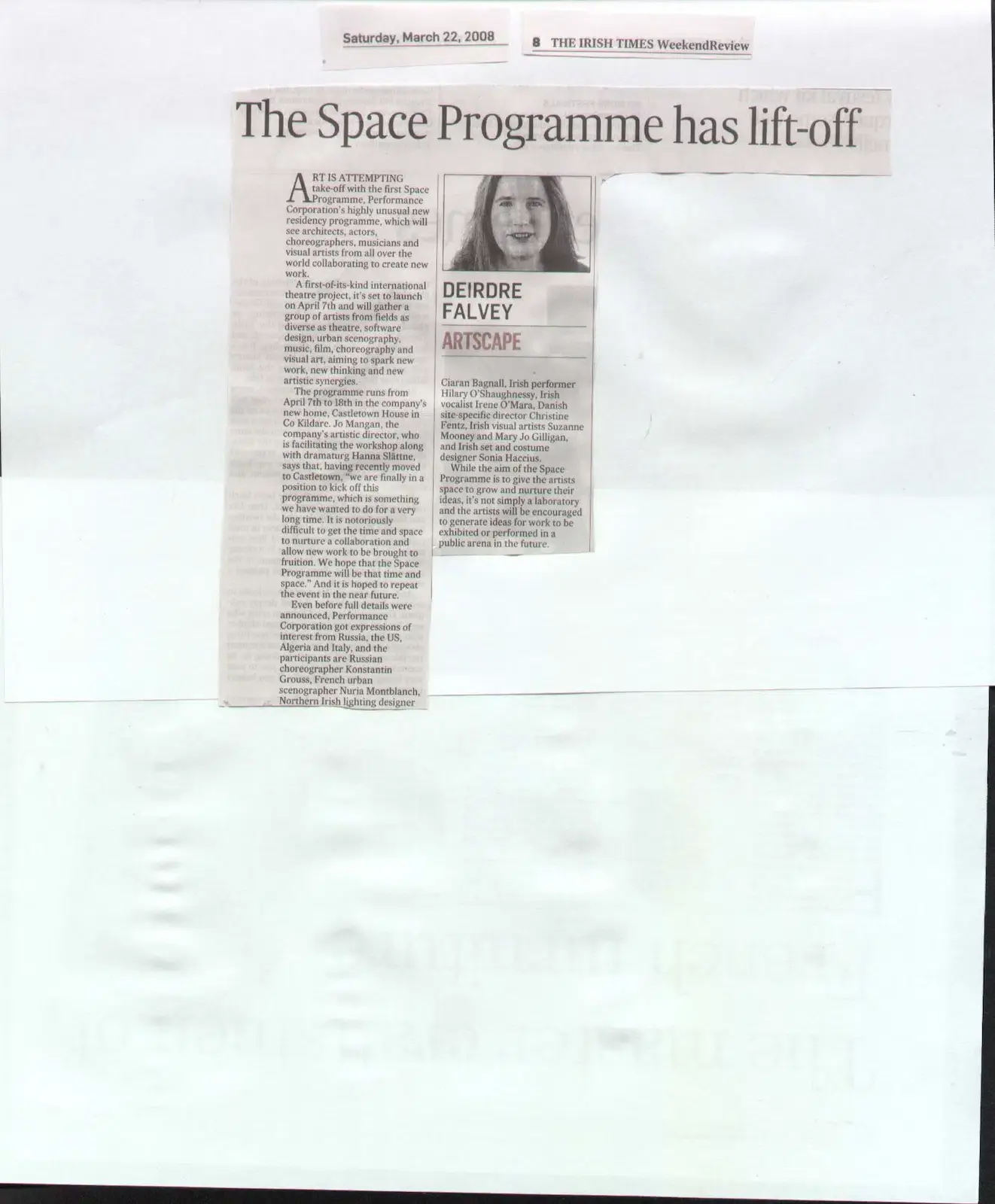
‘The Space Programme has lift-off’. Named in the participant list for the Performance Corporation residency at Castletown House.
Irish Independent
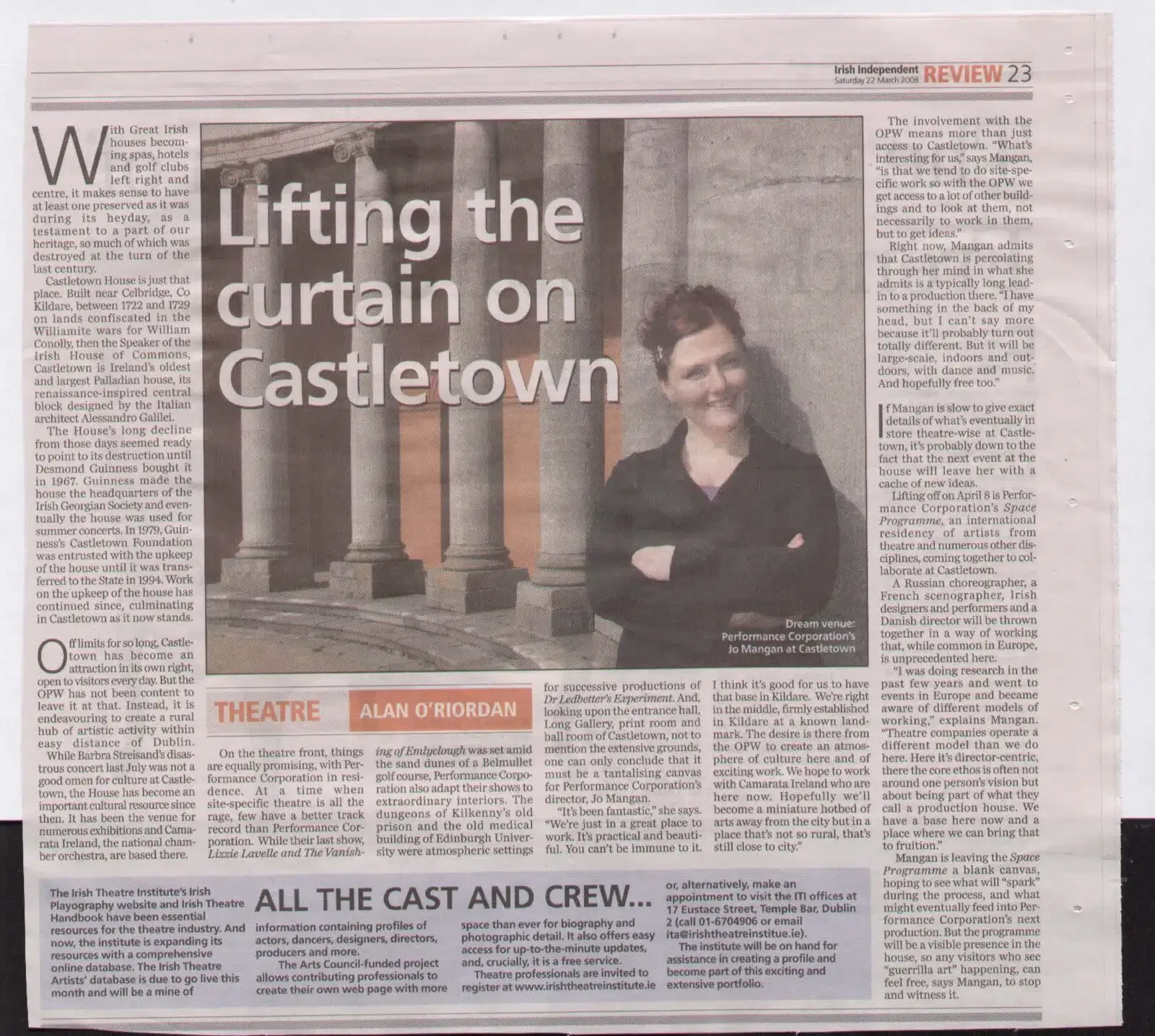
‘Lifting the curtain on Castletown’. ‘A Russian choreographer, a French scenographer, Irish designers and performers and a Danish director…’
sdarch.it · salab.org
The Balancing Pavilion / Pinecone Pavilion competition result, listed internationally.
On camera
Four recordings across sixteen years. Three were made by other people — two broadcasters and an Irish company; none of this was filmed by him. Click to play — until you do, only the still frame loads, not the player or its trackers.
Telekanal Kultura — national news broadcast
State television at the Pushkin Museum during the December Nights festival, with the dance theatre ZERO named on air.
A copy is kept at the Internet Archive
The Performance Corporation — The Space Programme Long Edit
The company’s own film of the residency at Castletown House, Ireland. Every participant speaks to camera — his earliest recorded words in English.
TV Tsentr (TVC) — news broadcast from Povarskaya 20
The earliest recorded telling of the Dublin origin, in the Art-Residence rooms of Anatoly Vasiliev’s first theatre building.
Filmed interview
The last sustained statement before Bali: the definition of dance in three words, and the sentence explaining why a choreographer curates.
Filmed at the Guslitsa art estate.
Everything, by project
Ninety-five sources, 2003–2026, grouped not by year but by strand of work. An item may appear in two sections — that is deliberate. Open the one you need.
Theatre ZERO — choreography · 2003–200814 sources
The company years: the first performances, the first reviews, and the first demolition.
The Cage line, with Alexei Lubimov · 2004–201314 sources
Nine years of John Cage with the pianist Alexei Lubimov — the Moscow Conservatory, the Pushkin Museum, the St Petersburg Philharmonic, Norilsk.
International residencies · 2003–201312 sources
Not press, mostly: the programmes’ own participant lists and directories. They are the hardest evidence in the archive, and the least read.
Art-Residence, Povarskaya 20 · 2009–201613 sources
The festivals in Anatoly Vasiliev’s first theatre building: No Translations, extension.art, Architecture. Body. Dance, Random Gallery.
Art-Ovrag, Vyksa · 2011–202524 sources
Founder and curator of the 2011–2013 street-art and public-art festival in a steel town — and what the press wrote about it then and later, eleven years apart.
Kod Epokhi / Zeitgeist · 20138 sources
Ten days in March at the All-Russian Museum of Decorative and Folk Art. The most heavily covered thing in the archive, and the most critically assessed.
5th Moscow Biennale — ROOM ROOM ROOM · 20132 sources
An official special project of the Biennale, 20–25 September, curated with Alexandra Konnikova. The Biennale’s own pages survive only in the Wayback Machine.
Where Viewable · 20133 sources
24 October – 24 November 2013, ДК АЗЛК «Москвич».
Skolkovo and the Accelerator — curatorial commissions · 2013–20154 sources
Two commissions outside the festivals: the Skolkovo gallery, with «Алгоритм + вдохновение», and the Accelerator of New Moscow, whose closing exhibition Sluchaynost carried a Moscow Department of Culture subsidy.
Artistic projects and choreography, from 2009 · 2009–20187 sources
Where the dance work crosses into contemporary art: the interactive compositions, the Garage, Pisa, the State Theatre of Nations.
Objects and video · 2015–20194 sources
The turn to things that do not move: the kinetic sculptures, Round Panorama, and four seasons of straw ballerinas on a pond.
Ninety-five sources; one hundred and five placements — ten items belong to two strands at once. Those marked ‘record’ are not press but institutions’ own documents: residency participant lists, museum event pages, concert archives. They are the hardest evidence on this page. If you know of a publication that is missing here, please write.
Published, but not on the web
Twelve articles that exist nowhere else. Two of the publications have closed; four domains stopped resolving while this archive was being assembled; two appeared only in print. Each is reproduced here, with its scan, its full text and its original citation.
Twelve articles
- «Искра · Spark» · 04.2004 · print only
- «День за днем», Tallinn · 17.02.2006
- Moskauer Deutsche Zeitung · 28.05.2007 · print only
- The Irish Times · Irish Independent · 22.03.2008
- «Театральный МИР» №11 · 11.2010
- The Moscow News · 02.12.2010
- Novaya Gazeta · 07.12.2010
- «Московская перспектива» · 07.12.2010
- ArtRadar · 18.02.2013
- Moskovskie Novosti · 19.03.2013
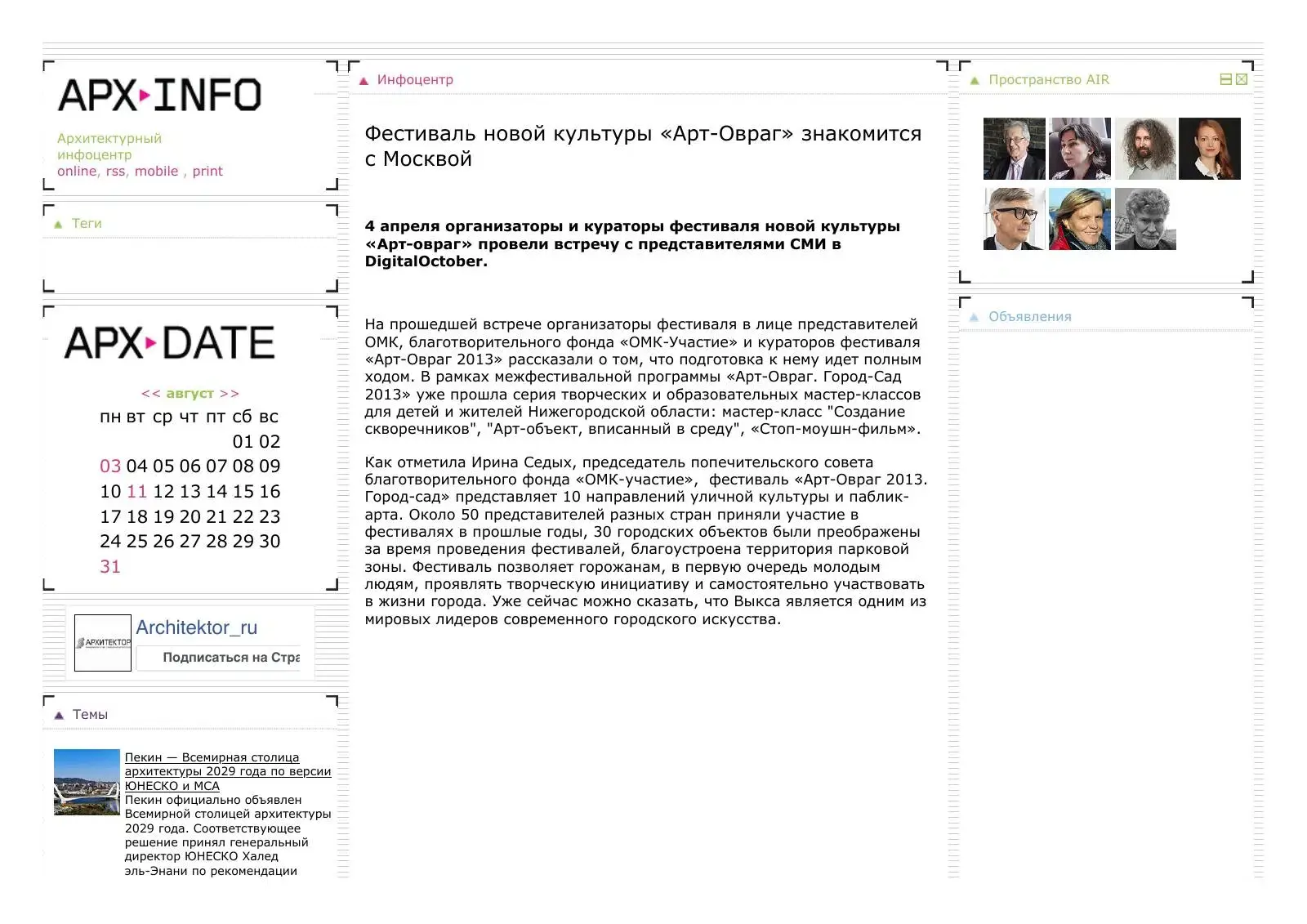
- architektor.ru · 04.2013
«Искра · Spark»
April 2004 · page 38, the «цех» section
The earliest interview in this archive, and the earliest document in it in which he speaks. Two pages on Theatre ZERO under the headline «Театр Зеро», billing him as «художник танца, хореограф-импровизатор» — artist of dance, choreographer-improviser. He explains what ZERO means, and says a thing about dance and the body that the next twenty years did not make him revise.
Open the scans (2)
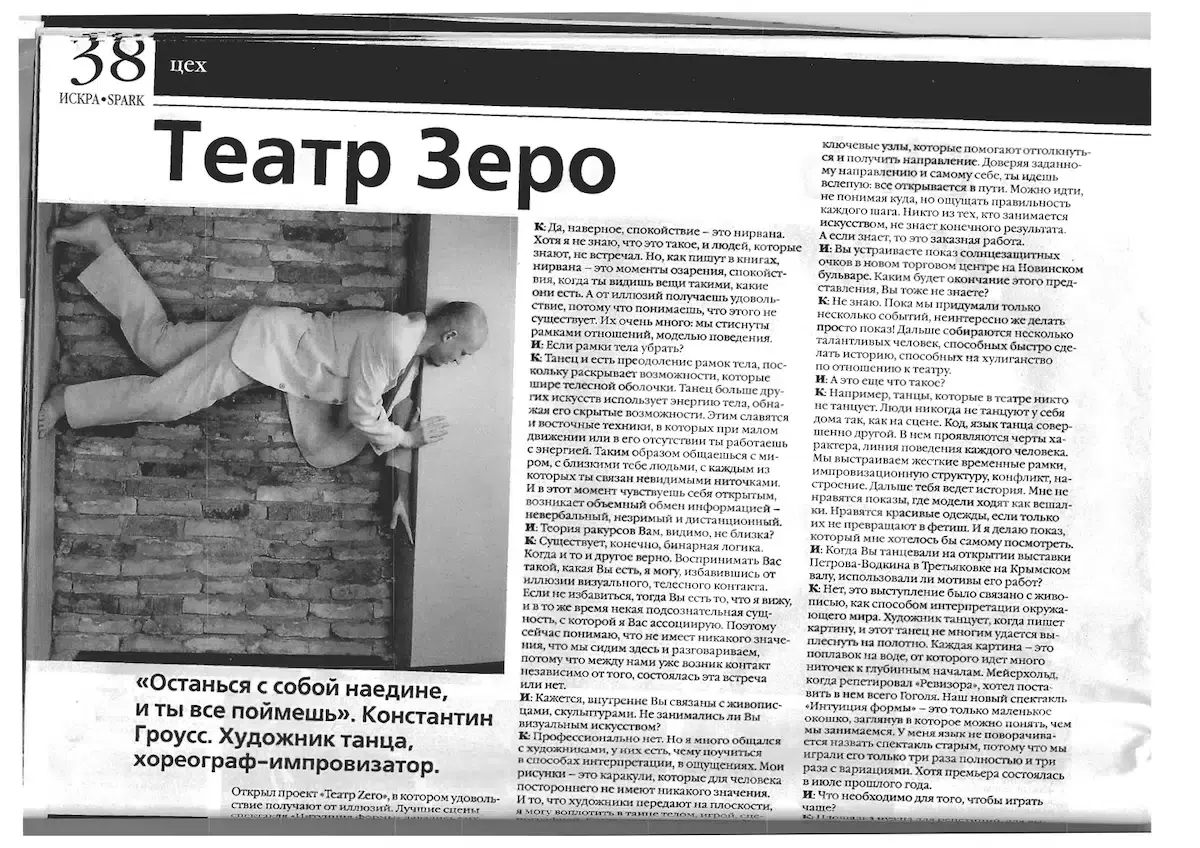
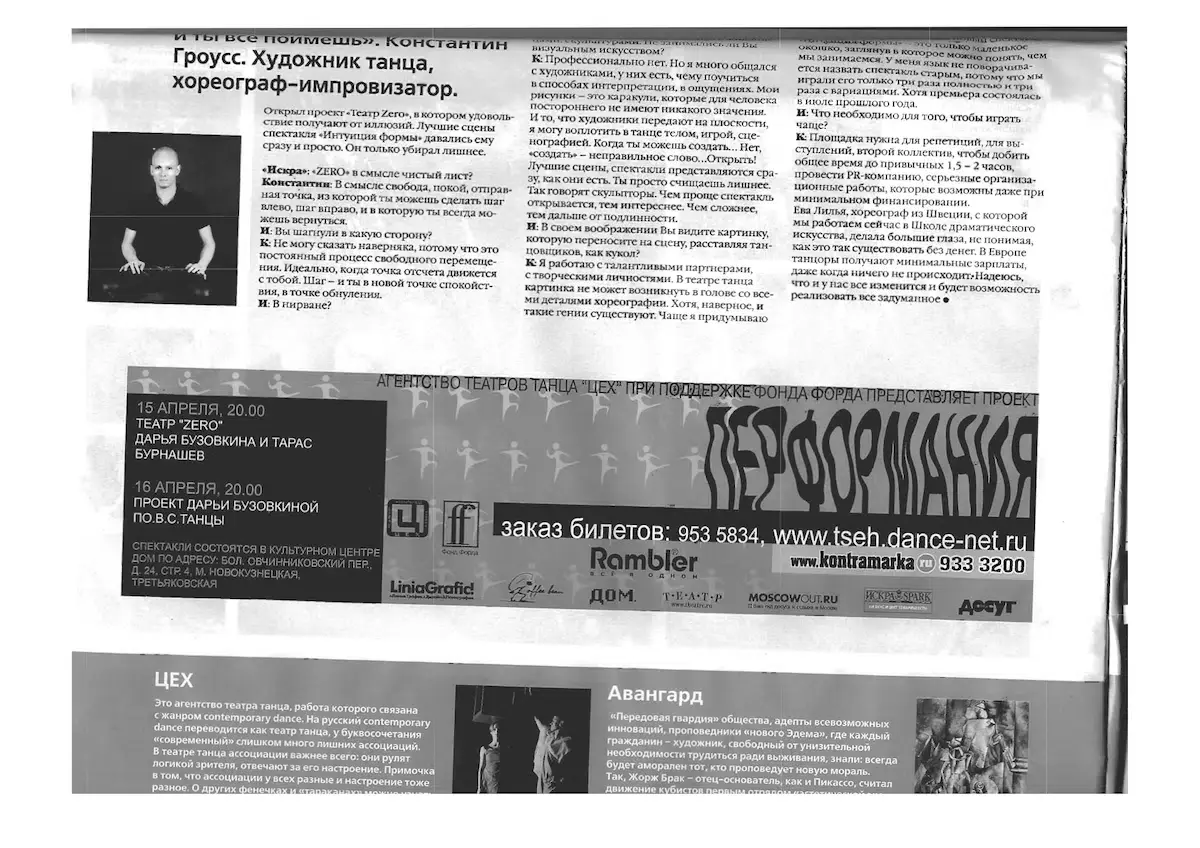
«Останься с собой наедине, и ты все поймешь»
‘Stay alone with yourself, and you will understand everything’ — the magazine’s own pull-quote, printed beside the photograph on page 38
The texts below are the artist’s own transcription of the conversation, checked against the scan above in September 2026.
Full text · English
“Zero” as in a blank slate?
As in freedom, peace, a starting point from which you can take a step to the left, a step to the right, and to which you can always return.
Which way did you step?
I can’t say for sure, because we’re constantly stepping, moving freely. Ideally, the reference point moves with you. One step—and you’re at a new point of calm, at the zero point.
So, in nirvana?
I suppose tranquility is nirvana. Although I don’t know what it is, and I haven’t met anyone who does. But judging by what they write in books, nirvana is moments of insight and tranquility, when you see things as they really are. And you derive pleasure from illusions because you understand that they are illusions. There are so many of them: we are confined by our bodies, the boundaries of relationships, and behavioral patterns.
What if we were to remove the boundaries of the body…?
Dance is precisely the transcendence of the body’s boundaries; it reveals possibilities that extend beyond the physical shell. More than any other art form, dance harnesses the body’s energy, revealing its hidden potential. This is what makes Eastern techniques so remarkable—in them, with minimal movement or none at all, you work with energy. And while in a state of stillness, you connect with the world, with those close to you, each of whom you’re bound to by invisible threads. And at that moment, you feel open, a multidimensional exchange of information arises—nonverbal, invisible, and remote.
The theory of perspectives is apparently not your thing…
There is, of course, binary logic—when both are true. When you perceive something, you yourself create it. I can only perceive you as you truly are by freeing myself from the illusion of visual and physical contact. If I don’t let go of that, then you are what I am—that is, a certain subconscious essence of mine through which I perceive you. I can now understand that it doesn’t matter at all that we’re sitting here talking, because there is contact between us regardless of whether this meeting actually took place or not.
It seems that, deep down, you’re connected to painters and sculptors—have you ever been involved in the visual arts?
Not professionally. But I’ve spent a lot of time with artists; there’s a lot to learn from them in terms of ways of interpretation and sensations. What I draw are just scribbles that mean nothing to an outsider. And what artists convey on a flat surface, I can embody through the body, dance, physical theater, and set design. When you can create… no, “create” isn’t the right word… REVEAL! The best scenes and performances — they simply reveal themselves, presenting themselves immediately, just as they are. You simply strip away the excess. That’s what sculptors say. The more simply a performance reveals itself, the more interesting it is. The more complicated it is, the further it is from authenticity.
In your imagination, do you see an image that you then bring to the stage, arranging the dancers like puppets?
I work with talented partners, creative individuals. An image of a dance theater production can’t just pop into your head with all the details of the choreography. Although, I suppose there are geniuses like that. In “Intuition of Form”, for example, key points are devised that help you use them as a springboard to find direction. By trusting the given direction and yourself, you move forward blindly, and everything reveals itself along the way. You can move forward without knowing where you’re going, but still feel that every step is right. No one involved in art knows the final result. And if they do—then it’s a commissioned work, which, by the way, anyone could have commissioned for themselves.
What, even when participating in a sunglasses showcase at the new shopping center on Novinsky Boulevard, you don’t know the outcome either?
I don’t know. So far, we’ve only come up with a few events—it’s no fun to just put on a show! Next, we’re bringing together a few talented people capable of making history quickly, capable of being a bit of a troublemaker when it comes to the theater…
And what is this, then?
For example, dances that no one performs in the theater. People never dance at home the way they do on stage. The code, the language of dance, is completely different. Each person’s character traits and behavioral patterns come to the fore. We build a rigid improvisational structure, a conflict, strict time frames, and a mood. Then the story takes you from there. I don’t like fashion shows where models walk around like clothes hangers. I like beautiful clothes when they aren’t turned into a fetish. And I put on a show that I myself would like to see.
When you danced at the opening of the Petrov-Vodkin exhibition at the Tretyakov Gallery on Krymsky Val, did you use motifs from his works?
No, the performance was connected to painting as a way of interpreting the world around us. An artist dances when painting a picture, and not many manage to capture that dance on the canvas. Every painting is like a float on the water, from which many threads lead to deeper origins, sources, and themes. When Meyerhold was rehearsing “The Inspector General”, he wanted to incorporate all of Gogol into it. Our production, “Intuition of Form”, is just a small window—by looking through it, you can understand what we do.
Which production, in terms of number, will you be performing in April?
Dasha Buzovkina asked me, “Will you be performing the old or the new production?” but I can’t bring myself to call it the “old” production, because we’ve only performed it three times in its entirety and three times with variations. Even though the premiere took place last July.
What can we do to perform more often?
We need a venue for rehearsals and performances, a second troupe to bring our total performance time up to the usual 1.5–2 hours, a PR campaign, and serious organizational work—all of which are possible even with minimal funding.
Efva Lilja, the choreographer from Sweden, we’re currently working with at the School of Dramatic Arts, was wide-eyed, unable to understand how it’s possible to exist without money. In Europe, dancers receive minimum wages even when there are no performances. I hope that things will change here too, and that we’ll have the opportunity to make everything we want a reality.
Full text · the Russian original
«Зеро» в смысле чистый лист?
В смысле свобода, покой, отправная точка, из которой ты можешь сделать шаг влево, шаг вправо, и в которую ты всегда можешь вернуться.
Вы шагнули в какую сторону?
Не могу сказать наверняка, потому что мы шагаем постоянно, свободно перемещаемся. Идеально, когда точка отсчета двигается вместе с тобой. Шаг – и ты в новой точке спокойствия, в точке обнуления.
То есть в нирване?
Наверное, спокойствие – это нирвана. Хотя я не знаю, что это такое, и людей, которые знают, не встречал. Но, судя по тому, что пишут в книгах, нирвана – это моменты озарения, спокойствия, когда ты видишь вещи такими, какие они есть. А от иллюзий испытываешь удовольствие, потому что понимаешь, что это иллюзии. Их очень много: мы стиснуты телом, рамками отношений, моделями поведения.
Если рамки тела убрать..?
Танец и есть преодоление рамок тела, он раскрывает возможности, которые шире телесной оболочки. Танец больше других искусств использует энергию тела, обнажая его скрытые возможности. Этим славны и восточные техники, в которых при малом движении или в его отсутствии ты работаешь с энергией. И находясь в точке спокойствия, общаешься с миром, с близкими тебе людьми, с каждым из которых ты связан невидимыми ниточками. И в этот момент ты чувствуешь себя открытым, возникает объемный обмен информацией - невербальный, незримый и дистанционный.
Теория ракурсов тебе, видимо, не близка…
Существует, конечно, бинарная логика. Когда и то, и другое верно. Воспринимая вещь, ты сам ее творишь. Воспринимать тебя такой, какая ты есть, я могу, только избавившись от иллюзии визуального, телесного контакта. Если не избавиться, то тогда ты есть, то, что я есть, то есть некая моя подсознательная сущность, которой я тебя воспринимаю. Я могу сейчас понять, что не имеет никакого значения, что мы сидим здесь, говорим, потому что между нами есть контакт независимо от того, состоялась эта встреча или нет.
Кажется, внутренне ты связан с живописцами, скульптурами, ты не занимался визуальным искусством?
Профессионально нет. Но я много общался с художниками, у них есть, чему поучиться в способах интерпретации, в ощущениях. То, что я рисую – это каракули, которые для человека постороннего не имеют никакого значения. И то, что художники передают на плоскости, я могу воплотить телом, танцем, телесной игрой, сценографией. Когда ты можешь создать… нет, «создать» неправильное слово… ОТКРЫТЬ! Лучшие сцены, спектакли - просто открываются, представляются сразу, как они есть. Ты просто счищаешь лишнее. Так говорят скульпторы. Чем проще спектакль открывается, тем интереснее. Чем сложнее, тем дальше от подлинности.
В своем воображении ты видишь картинку, которую переносишь на сцену, расставляя танцовщиков, как кукол?
Я работаю с талантливыми партнерами, творческими личностями. Картинка театра танца не может возникнуть в голове со всеми деталями хореографии. Хотя, наверное, и такие гении существуют. В «Интуиции формы», например, придуманы ключевые узлы, которые помогают от них оттолкнуться и получить направление. Доверяя заданному направлению и самому себе, ты идешь вслепую, и все открывается в пути. Можно идти, не понимая куда, но ощущать правильность каждого шага. Никто из тех, кто занимается искусством, не знает конечного результата. А если знает – то это заказная работа, которую, кстати, каждый мог заказать себе сам.
Что, даже участвуя в показе солнцезащитных очков в новом торговом центре на Новинском бульваре, ты тоже не знаешь результат?
Не знаю. Пока мы придумали только несколько событий, не интересно же делать просто показ! Дальше собираются несколько талантливых человек, способных быстро сделать историю, способных на хулиганство по отношению к театру…
А это еще что такое?
Например, танцы, которых в театре никто не танцует. Люди никогда не танцуют у себя дома так, как на сцене. Код, язык танца совершенно другой. Проявляются черты характеры, линии поведения каждого человека. Мы выстраиваем жесткую импровизационную структуру, конфликт, жесткие временные рамки, настроение. Дальше тебя ведет история. Мне не нравятся показы, где модели ходят как вешалки. Мне нравятся красивые одежды, когда их не превращают в фетиш. И я делаю показ, который мне хотелось бы самому посмотреть.
Когда вы танцевали на открытии выставки Петрова-Водкина в Третьяковке на Крымском валу, вы использовали мотивы его работ?
Нет, выступление было связано с живописью, как способом интерпретации окружающего мира. Художник танцует, когда пишет картину, и этот танец не многим удается выплеснуть на полотно. Каждая картина – это поплавочек на воде, от которого идет много ниточек к глубинным началам, истокам, сюжетам. Мейерхольд, когда репетировал «Ревизора» хотел поставить в нем всего Гоголя. Наш спектакль «Интуиция формы» - это только маленькое окошко, заглянув в которое можно понять, чем мы занимаемся.
Какой по счету спектакль вы сыграете в апреле?
Даша Бузовкина спросила меня: «Вы будете играть старый или новый спектакль?», а у меня язык не поворачивается назвать спектакль старым, потому что мы играли его только три раза полностью и три раза с вариациями. Хотя премьера состоялась в июле прошлого года.
Что сделать для того, чтобы играть чаще?
Площадка нужна для репетиций, для выступлений, второй коллектив, чтобы добить общее время до привычных 1,5 – 2 часов, провести PR-компанию, серьезные организационные работы, которые возможны даже при минимальном финансировании.
Ева Лилия, хореограф из Швеции, с которой мы работаем сейчас в Школе драматического искусства, делала большие глаза, не понимая, как это так существовать без денег. В Европе танцоры получают минимальные зарплаты даже когда ничего не происходит. Надеюсь, что и у нас все изменится, и будет возможность реализовать все, что мы хотим.
Every page, the original and the transcript — at the Internet Archive
Published in print in «Искра · Spark», April 2004, p. 38, in the «цех» section; it was never online. Reproduced here as archival documentation. Rights remain with the author and the publisher — write, and it will be taken down.
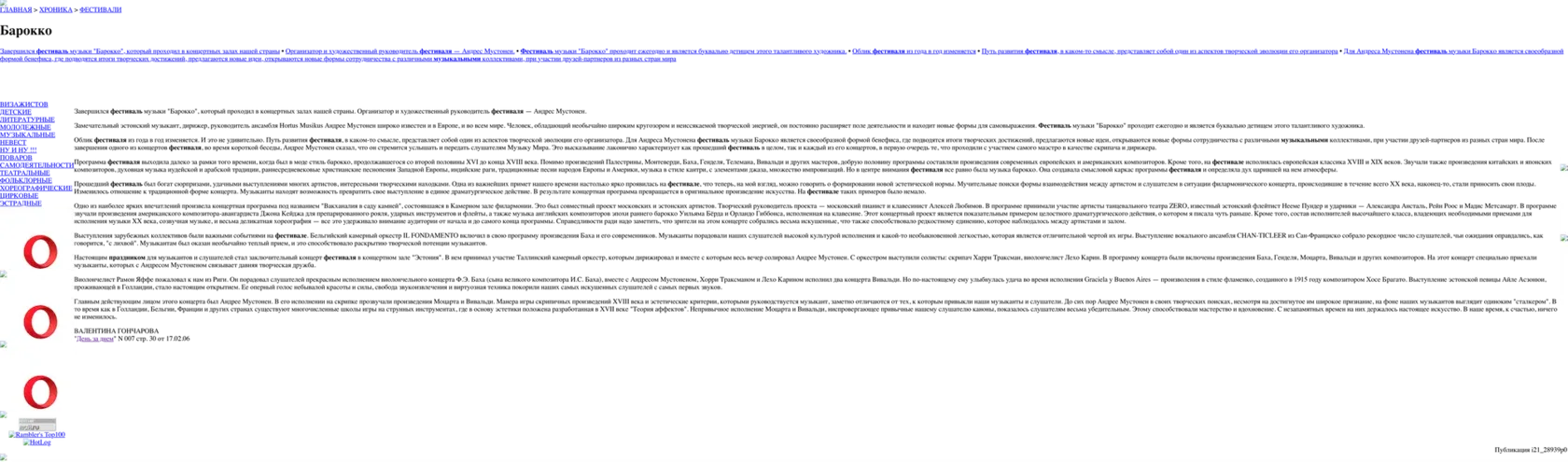
«День за днем», Tallinn
Valentina Goncharova · 17.02.2006
Bacchanale at Andres Mustonen’s Barocco festival.
Open the scan
Every page, the original and the transcript — at the Internet Archive
Originally published in «День за днем», Tallinn, 17.02.2006. Reproduced here as archival documentation; the publication is no longer available online. Rights remain with the author and the publisher — write, and it will be taken down.
Moskauer Deutsche Zeitung
Markus Huth · 28.05.2007
«Tanz zwischen Caesar und Perikles». A full profile in German; the most biographically informative article about him. Print only — it was never published on the web.
Open the scan
Every page, the original and the transcript — at the Internet Archive
Published in print in Moskauer Deutsche Zeitung, 28.05.2007; it was never online. Reproduced here as archival documentation. Rights remain with the author and the publisher — write, and it will be taken down.
The Irish Times · Irish Independent
Deirdre Falvey · Alan O’Riordan · 22.03.2008
Two national dailies of the same country, on the same Saturday.
Open the scans (2)
Every page, the original and the transcript — at the Internet Archive
Originally published in The Irish Times · Irish Independent, 22.03.2008. Reproduced here as archival documentation; the publication is no longer available online. Rights remain with the author and the publisher — write, and it will be taken down.
«Театральный МИР» №11
Irina Plotnikova · 11.2010
The Art-Residence manifesto, quoted in full.
Open the scan
Every page, the original and the transcript — at the Internet Archive
Originally published in «Театральный МИР» №11, 11.2010. Reproduced here as archival documentation; the publication is no longer available online. Rights remain with the author and the publisher — write, and it will be taken down.
The Moscow News
Natalya Voroshilova · 02.12.2010
The only English-language press quotation in the archive.
Open the scan
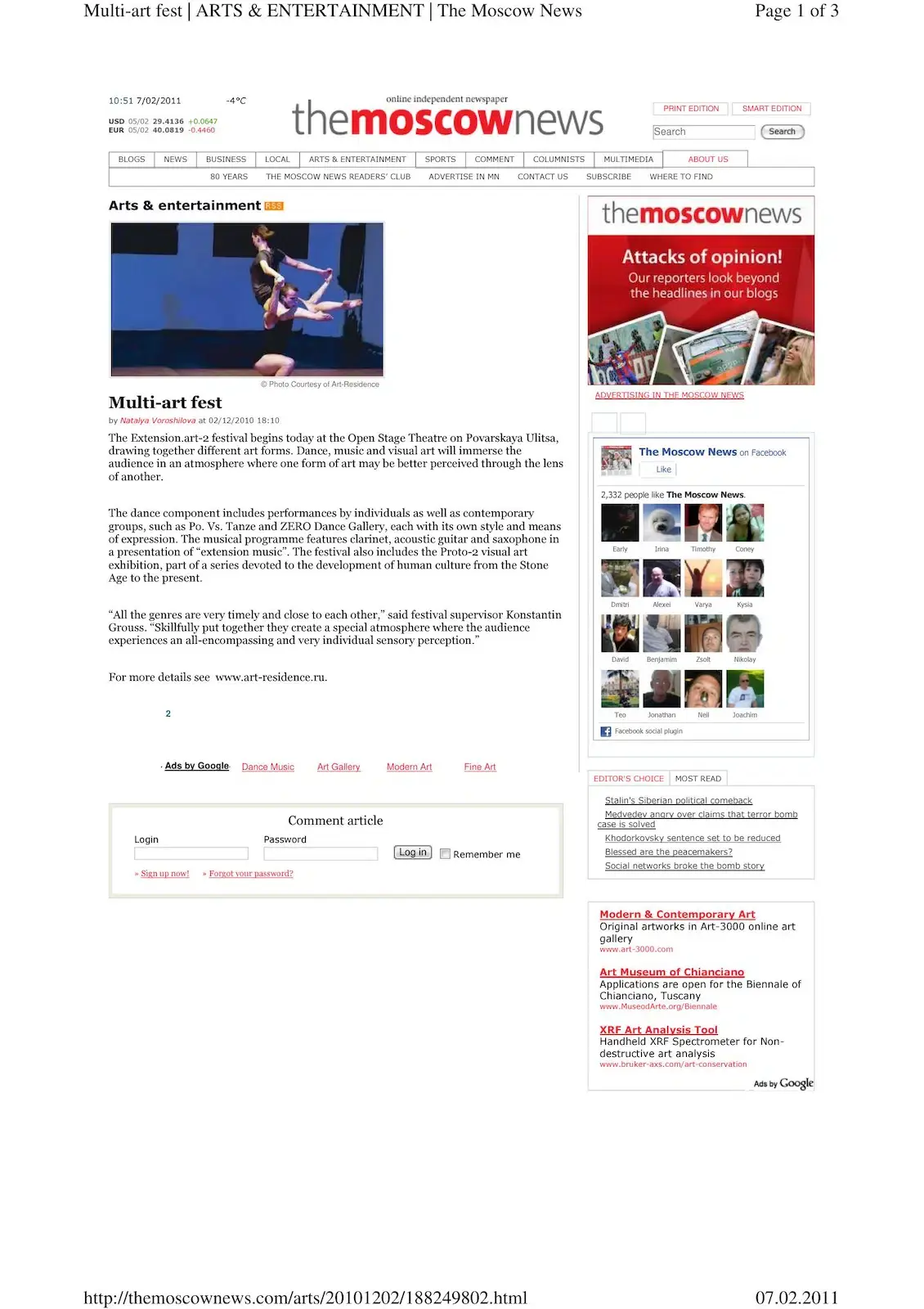
Every page, the original and the transcript — at the Internet Archive
Originally published in The Moscow News, 02.12.2010. Reproduced here as archival documentation; the publication is no longer available online. Rights remain with the author and the publisher — write, and it will be taken down.
Novaya Gazeta
Semyon Kashin · 07.12.2010
extension.art — 2.
Open the scan
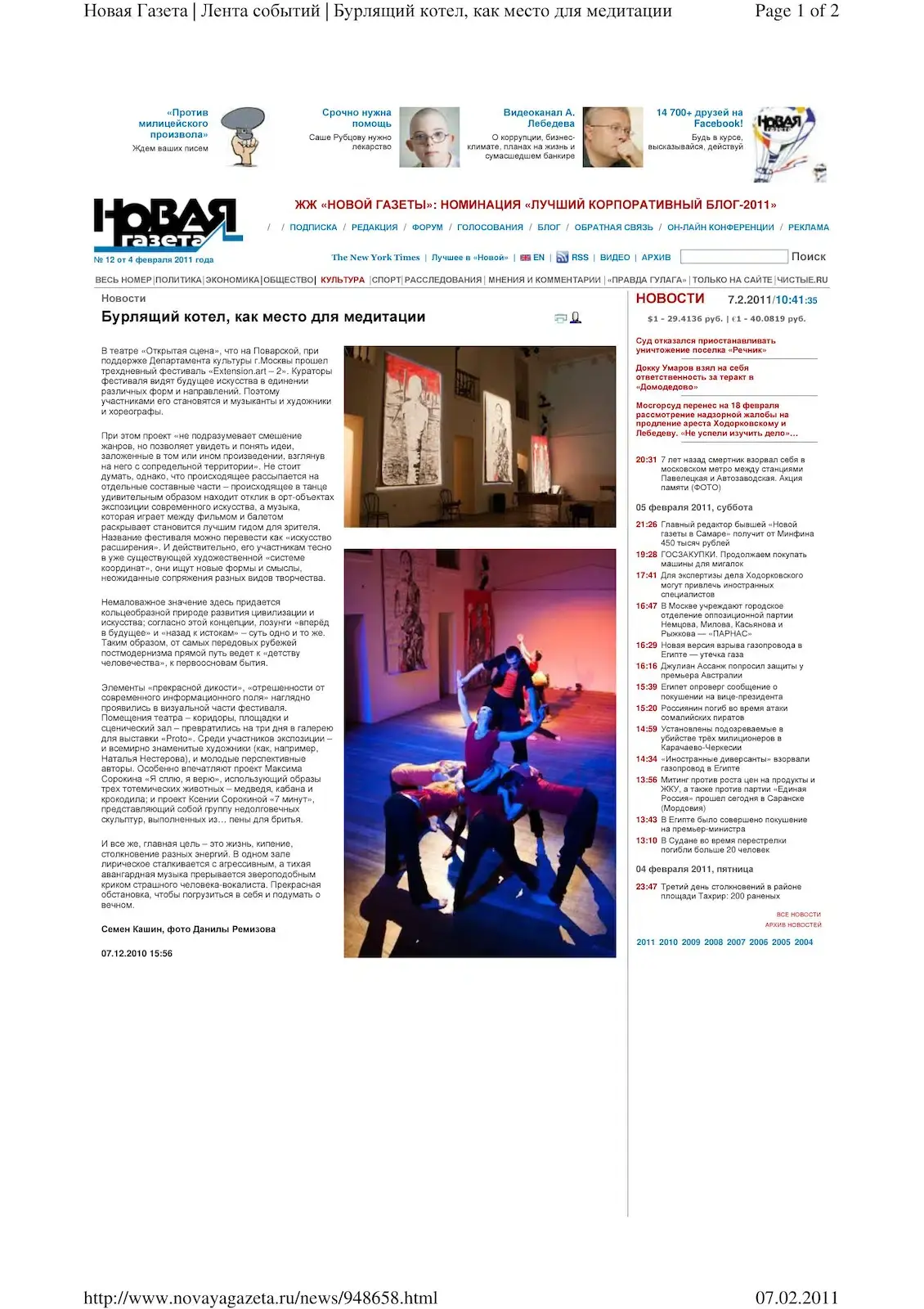
Every page, the original and the transcript — at the Internet Archive
Originally published in Novaya Gazeta, 07.12.2010. Reproduced here as archival documentation; the publication is no longer available online. Rights remain with the author and the publisher — write, and it will be taken down.
«Московская перспектива»
07.12.2010
The caption that names both curators of extension.art — 2.
Open the scan
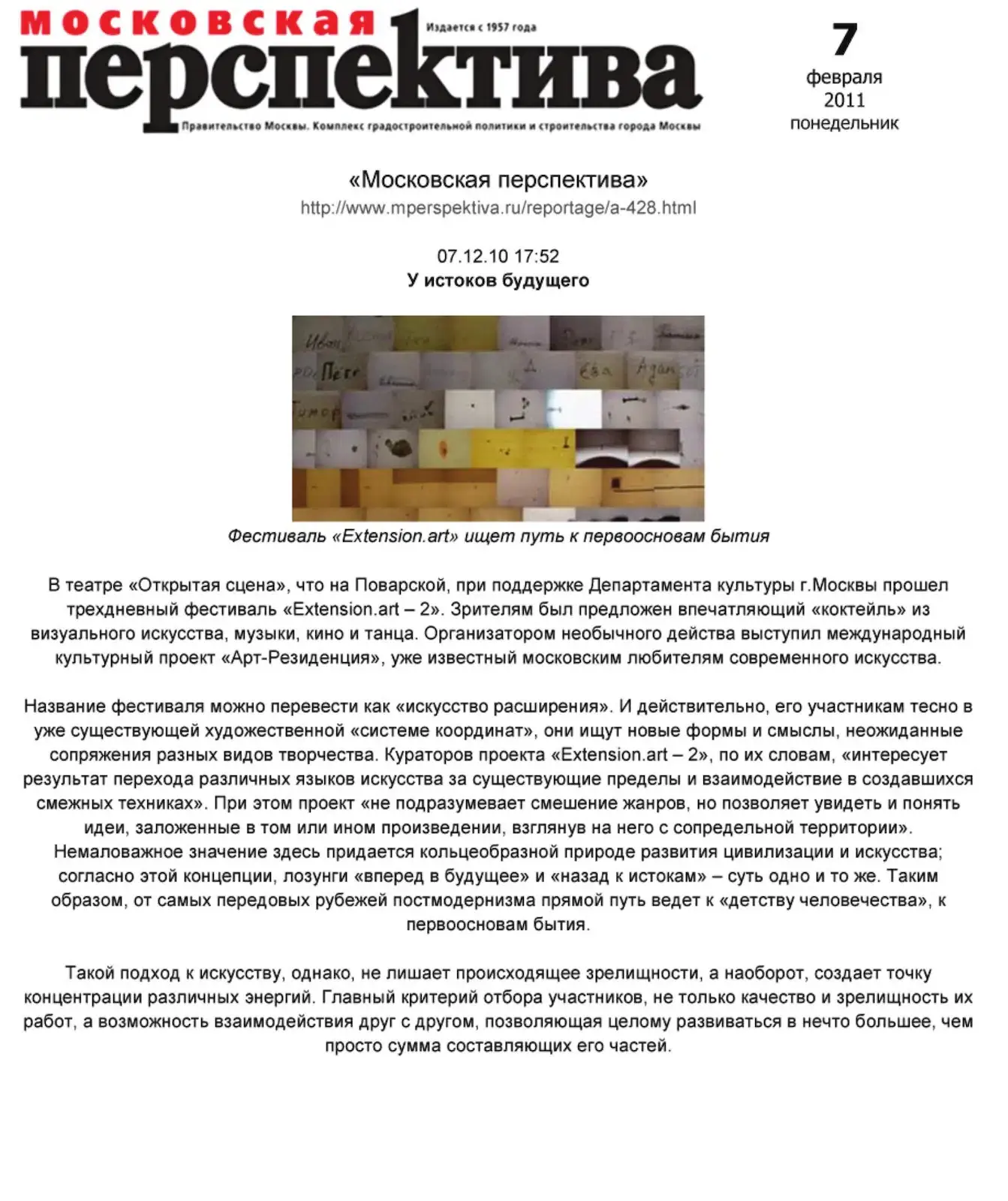
Full text · the Russian original
Фестиваль «Extension.art» ищет путь к первоосновам бытия
В театре «Открытая сцена», что на Поварской, при поддержке Департамента культуры г.Москвы прошел трехдневный фестиваль «Extension.art — 2». Зрителям был предложен впечатляющий «коктейль» из визуального искусства, музыки, кино и танца, Организатором необычного действа выступил международный культурный проект «Арт-Резиденция», уже известный московским любителям современного искусства.
Название фестиваля можно перевести как «искусство расширения». И действительно, его участникам тесно в уже существующей художественной «системе координат», они ищут новые формы и смыслы, неожиданные сопряжения разных видов творчества. Кураторов проекта «Extension.art — 2», по их словам, «интересует результат перехода различных языков искусства за существующие пределы и взаимодействие в создавшихся смежных техниках». При этом проект «не подразумевает смешение жанров, но позволяет увидеть и понять идеи, заложенные в том или ином произведении, взглянув на него с сопредельной территории». Немаловажное значение здесь придается кольцеобразной природе развития цивилизации и искусства; согласно этой концепции, лозунги «вперед в будущее» и «назад к истокам» — суть одно и то же. Таким образом, от самых передовых рубежей постмодернизма прямой путь ведет к «детству человечества», к первоосновам бытия.
Такой подход к искусству, однако, не лишает происходящее зрелищности, а наоборот, создает точку концентрации различных энергий. Главный критерий отбора участников, не только качество и зрелищность их работ, а возможность взаимодействия друг с другом, позволяющая целому развиваться в нечто большее, чем просто сумма составляющих его частей Антон Пономарев (слева), Алексей Чичилин Балет Дениса Бородицкого лежит на грани танца и акробатики
Подписи к фотографиям: Тимофей Караффа-Корбут (слева), Константин Гроусс, кураторы проекта · Антон Пономарев (слева), Алексей Чичилин · Балет Дениса Бородицкого лежит на грани танца и акробатики · На фестивале даже банан может быть съеден в танце · «Все плохое на этой земле должно быть исправлено». Наталья Нестерова · По. В.С.Танцы: иногда танец позволяет взглянуть на мир с другой стороны · Происходит слияние зрителя с произведением · Протоискусство не чурается монументальности · Хорошему танцору не помешают и связанные шнурки
Every page, the original and the transcript — at the Internet Archive
Originally published in «Московская перспектива», 07.12.2010. Reproduced here as archival documentation; the publication is no longer available online. Rights remain with the author and the publisher — write, and it will be taken down.
ArtRadar
18.02.2013
The long interview on what ‘contemporary’ means in dance.
Open the scan
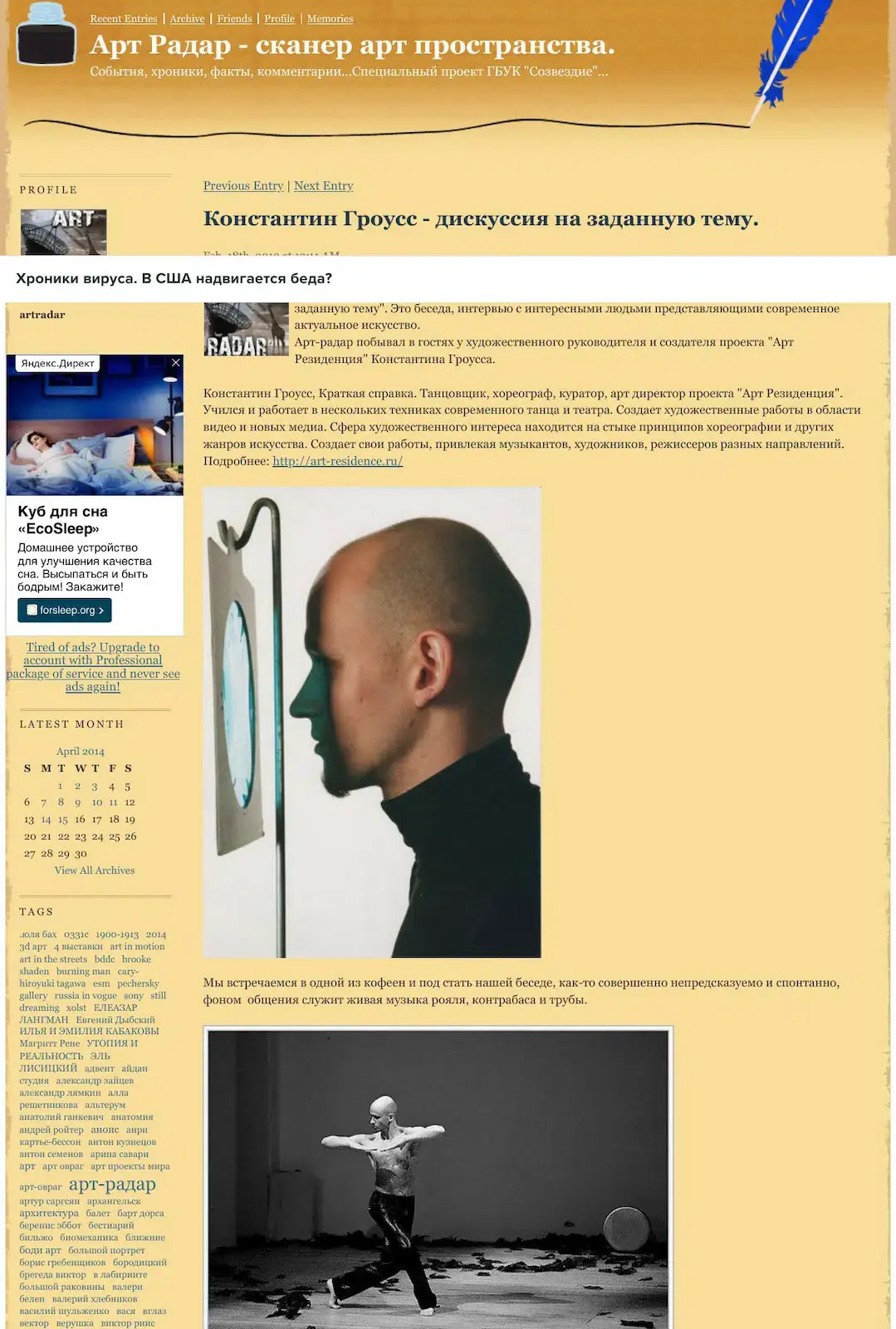
Every page, the original and the transcript — at the Internet Archive
Originally published in ArtRadar, 18.02.2013. Reproduced here as archival documentation; the publication is no longer available online. Rights remain with the author and the publisher — write, and it will be taken down.
Moskovskie Novosti
Anastasia Gladilshchikova · 19.03.2013
The fullest description of him dancing that anyone published.
«Танец Гроусса впечатляет. В нем действительно важна энергия, которая становится вторым главным действующим лицом номера»
‘Grouss’s dance is striking. Energy really does matter in it, becoming the second protagonist of the piece’
No scan of this issue survives, and Moskovskie Novosti closed in 2014 with its archive. The text below is the article in full: it was copied from the paper’s site while the page was still live, and kept in the festival’s own report. The original address, mn.ru/culture/20130319/340309489.html, now returns nothing. If you hold the printed issue of 19 March 2013, please write.
Full text · the Russian original
В Музее декоративно-прикладного и народного искусства проходит фестиваль современного искусства «Код эпохи»
«Код эпохи» – это символ, вбирающий в себя весь контекст сегодняшнего дня. Так расшифровано название фестиваля на его официальной странице в «Фейсбуке». В рамках «Кода эпохи» работает выставка современного искусства, играют новую музыку, показывают современный танец, обсуждают философские проблемы. Фестиваль проходит с 14 по 24 марта, его активная фаза с многочисленными выступлениями пришлась на 14-17 марта. «Московские новости» посетили фестиваль в один из дней его работы.
В музее, который похож на город-лабиринт, немудрено заблудиться. Именно это и случилось бы, если бы меня не проводили до зала, где проходит круглый стол «Код эпохи. Возможна ли расшифровка?». Умнейшие люди, среди которых ученые, философы, художники Алла Митрофанова, Елена Петровская, Валерий Подорога, Кирилл Мартынов, Майк Хенц, обсуждают, что такое «код эпохи», современность, ее границы, современное искусство и многое другое, спорят или, наоборот, соглашаются друг с другом. Чтобы передать дискуссию, длившуюся два с половиной часа, возможно, не хватит и целого научного сборника. Кстати, организаторы фестиваля заранее озаботились масштабами темы и выпустили буклет со сборником статей, подготовленных участниками круглого стола, и не только ими. Можно посмотреть в музее и серию видеоинтервью по этой же проблематике.
Круглый стол завершает один из кураторов фестиваля хореограф Константин Гроусс (второй куратор – художник и архитектор Дмитрий Алексеев) – он объясняет, как организаторы понимают термин «код эпохи»:
– Может быть, у очень разных вещей и идей, которые воплощают художники, есть общий источник, я имею в виду художников в самом широком смысле. Мы пригласили к участию музыкантов, хореографов, чтобы понять некий общий процесс, который есть в искусстве и, может быть, уловить какие-то ходы к источнику, из которого черпается вдохновение. Но речь не только о профессиональном междусобойчике. Художники ищут способы воплотить его в образах и словах, а источник – «общий для всех людей». И искать его, очевидно, стоит в плоскости «общих кодов, общего смысла и общего языка». Я приступаю к поискам.
После круглого стола осматриваю выставку. Здесь есть все, чему полагается быть на выставках современного искусства: инсталляции, видеообъекты, минималистичные скульптуры (Дима Хунцельвег, High speed train), интерактивные объекты, связанные с современным миром (например, работа vtol «Финансовые риски» – роботоподобная машина, в которую нужно вставить свою банковскую карту, что приводит к некоторым звуковым и видеоэффектам). Есть здесь менее известные художники, есть и более известные: свои работы представили, например, Арсений Жиляев и Recycle. Можно увидеть творчество не только русских, но и иностранных художников. Почти каждый экспонат сопровожден подробным описанием, без которого иногда даже сложно понять, что представляет собой та или иная работа. Внимание многих, в том числе и мое, привлекают толстые книги, изрезанные таким образом, что напоминают горные породы (Кристин Алксне, Work book). В этом буйстве современного искусства есть и экспонаты, привычные для музея прикладного искусства: скворечники, сундуки, расписанные двери. Эффект получается, прямо скажем, впечатляющий.
Пока жду начала концерта, сидя на белой лавке, решаю поговорить со своей случайной соседкой. Спрашиваю, как она восприняла выставку и часто ли вообще ходит на подобные мероприятия.
Она отвечает не только на мои вопросы, но и рассуждает: появление современного искусства в традиционных музеях – вещь хорошая, позволяет разным поколениям по- новому посмотреть друг на друга.
Периодически к женщине подходит, видимо, ее сын, но быстро убегает: ему явно интереснее бегать по выставке, чем сидеть и ждать концерта.
– Моему ребенку интересно на этой выставке, он для себя что-то нашел. Молодых художников очень сложно объяснить ребенку, но здесь две-три работы объяснить можно. Потом оказывается, что эта женщина – видеохудожник Зоя Инкенас, но о ее профессии я узнаю не от нее. Она также сообщает мне, что на выставках маститых современных художников проще: их ребенку объяснять интереснее.
Начинается музыкальная программа. Сначала пианистка Елизавета Миллер и скрипач Станислав Малышев исполняют Road movies Джона Кулиджа Адамса. Это вещь 1995 года, выглядит традиционно. Потом выходит ансамбль «Студия новой музыки». Они играют российскую премьеру «Октета» американского композитора-минималиста Стива Райха. Создается впечатление, что в этой наполненной энергией вещи все время повторяется одна и та же тема, нагнетающая состояние тревоги. В перерыве разговариваю со знакомой флейтисткой, студенткой Московской консерватории Анной Кондрашиной, которая сегодня играла вместе со «Студией новой музыки». Спрашиваю, действительно ли «Октет» состоит из постоянных повторов или это иллюзия. Анна объясняет:
– Да, безусловно, там есть и повторения, но у каждого инструмента во всем произведении несколько наборов тем. Они закольцовываются и повторяются определенное количество раз. Потом следующая тема. Они переплетаются между собой у всех исполнителей, и получается то, что ты слышала. Это совокупность ритма и минималистической мелодии, похоже на транс.
Анна Кондрашина, флейтистка, студентка 5-го курса МГК имени Чайковского, факультет исторического и современного исполнительского искусства, лауреат международных конкурсов
— В исполнении современной музыки всегда очень помогает то, как композитор фиксирует на нотной бумаге свои пожелания. Если сравнить ноты мастеров XVII–XVIII веков и XX–XXI веков, то в первом случае увидишь голый текст, с одним знаком нюансировки в начале, а во втором – черные от записей листы, с уточнениями самых разных эмоций и техники. Большое количество написанного, безусловно, облегчает путь к исполнению. Не может не радовать также то, что современные композиторы стали использовать флейту как гораздо более самостоятельный и интересный инструмент по сравнению с мастерами прошлых веков. Звуковые, тембральные и эмоциональные возможности флейты несравнимо расширились с появлением «новой» музыки.
– То есть можно сказать, что у композитора и исполнителей и задача такая — ввести слушателей в транс?
– Да. Главное – не входить в транс самой, когда играешь, а то невольно переходишь на место слушателя и силой заставляешь себя вернуться.
– А можно ли сказать, что современная музыка обращается больше к разуму, а не к чувствам, или это не так?
– Можно сказать и так, – соглашается Аня и читает мне небольшую лекцию по истории музыки: – Полифоническая музыка – это «этап разума», в ней все рассчитано до такой степени, что если какую-нибудь инвенцию или фугу начать с середины и играть обратно к началу, то сложится не менее прекрасная музыка, чем если играть стандартным способом «слева направо». Затем «этап чувств» – от поздних классиков (Людвиг ван Бетховен) до поздней романтики (Антон Брукнер, Густав Малер, Сезар Франк и другие). За ними созерцательные Дебюсси и Равель. К третьему десятилетию XX века кто-то вернулся к барокко, а соответственно, и к «математическому» восприятию музыки. Современную музыку трудно обобщать, она очень многогранна.
Анна задумывается на секунду и подводит окончательный итог: «Думаю, что да, она больше обращается к разуму».
Наступает черед танца. На сцену выходит Константин Гроусс, один из создателей и художественный руководитель танцевального проекта ZERO Dance Gallery. Он говорит о том, что хотел бы ограничить время своего перформанса, и заводит на одно и то же время будильник и какой-то гаджет, который я не могу рассмотреть издалека. Константин произносит метафизический монолог о том, что танец — это прежде всего информация, и он с помощью силы воображения совершает некое путешествие, которое нацелено на то, чтобы добраться до того источника безграничной энергии, который и передает информацию в танце.
– Смысл и ценность этой информации я определить не возьмусь. Не возьмусь даже определить ее символы, – с ходу разочаровывает зрителей Константин, но тут же добавляет: – Впрочем, у вас же есть возможность перевести все на какой-то понятный язык – символов, значков, слов, рисунков. Если под рукой есть листы, вы можете это записать, чтобы передать, оставить себе или кинуть на сцену в течение представления.
Танец Гроусса впечатляет. В нем действительно важна энергия, которая становится вторым главным действующим лицом номера. Хореограф как будто впускает ее в себя, внимательно изучает. Вот его рука дрожит, наполняясь этой энергией и начиная жить собственной жизнью. Потом он явно пытается бороться с этой неведомой силой, драться. Во всем этом, так же как и в «Октете» Райха, чувствуется страшная тревога, которую усиливает музыка, похожая на шумы. Видимо, таков код нашего неспокойного времени, в котором художники и черпают вдохновение.
Константин Гроусс, художественный руководитель международного культурного проекта «Арт-Резиденция», хореограф, куратор фестиваля
— Я передаю какую-то информацию, а интерпретация может быть достаточно вольной – у каждого своей, причем день ото дня она может меняться. Мне кажется, во многом это касается любого невербального искусства, невербального способа передачи информации. Есть какие-то принятые нами системы обмена информацией – например, языковые, нотные, звуковые, – которые мы можем интерпретировать. Хотя, несмотря на то, что музыка поддается нотной записи, в точности передать смысл произведения вы не можете. Что такое пауза, высота звука? Мы не можем до конца сказать, что для нас означают звуковые сочетания. То же самое можно сказать и о танце.
Следующим на сцене появляется хореограф Денис Бородицкий, представляя свою танцевальную команду Boroditsky Dennis Dance Company.
– Мы заявляли работу, которая называется «В кубе». Но неделю назад я предложил своим ребятам пуститься в авантюру и сделать за это время новый номер на новую музыку. Я долго думал о том, что такое «код эпохи», рассуждал, что такое эпоха. До сих пор не могу расшифровать эти понятия. Тогда я обратился к себе, чтобы определить, что для меня является эпохой. В итоге в своей работе я обратился к музыке самого древнего народа – еврейского. Я еврей и очень долго боялся взяться за эту сложную для меня тему. Но, отбросив все страхи, за неделю мы сделали этот проект. Дело, конечно, не в национальности: эта работа позволила нам заглянуть внутрь себя. Я считаю, что для моих артистов это тоже начало пути.
Восемь человек в черных костюмах выходят на сцену. Музыка, которую исполняют канторы в синагогах, непередаваемо красива. Все очень строго, выдержанно и серьезно. Тут есть драматургия, отношения между персонажами, страдания, высказанные языком тела. У меня появляются ассоциации с античными трагедиями – эти ощущения подкрепляет и то, что часто танцоры застывают в разных позах, подобно древним статуям. О современной эпохе, наоборот, забываешь, но от этого становится почему-то хорошо.
Завершает программу знаменитый ансамбль ударных инструментов Марка Пекарского. Они исполняют композиции 1990-х годов. Передо мной полулежит на лавке девочка в розовом дутом комбинезоне и шапке с оленьими ушами и рисует на iPad цветок. Периодически родители просят ее раздеться, но девочка их не слушает. Когда музыка ансамбля становится совсем громоподобной и напоминает колокольный звон, девочка зажимает уши. Но не уходит.
Originally published in Moskovskie Novosti, 19.03.2013. Reproduced here as archival documentation; the publication is no longer available online. Rights remain with the author and the publisher — write, and it will be taken down.
architektor.ru
04.2013
The Art-Ovrag press conference. The domain lives; the page does not.
Open the scan
Every page, the original and the transcript — at the Internet Archive
Originally published in architektor.ru, 04.2013. Reproduced here as archival documentation; the publication is no longer available online. Rights remain with the author and the publisher — write, and it will be taken down.
2003